Showing posts with label Graal Cloud Native. Show all posts

Monday, May 27, 2024

Graal Cloud Native Tools Release - 4.2.1

With the latest release of the Graal Cloud Native Extension Pack for VS Code, we have added some great new features that will make working with Graal Cloud Native even better.

This release brings:

  • Support for the Micronaut® Framework Expression Language
  • Further enhancements to our support for working with the Oracle Autonomous Database
  • Support for the Micronaut Control Panel
  • Support for Config Maps for Graal Cloud Native applications deployed to Oracle Cloud Infrastructure Container Engine for Kubernetes (OKE)
  • A guide for running a Graal Cloud Native application on Google Cloud Run, from within VS Code

Micronaut Framework Expression Language Support


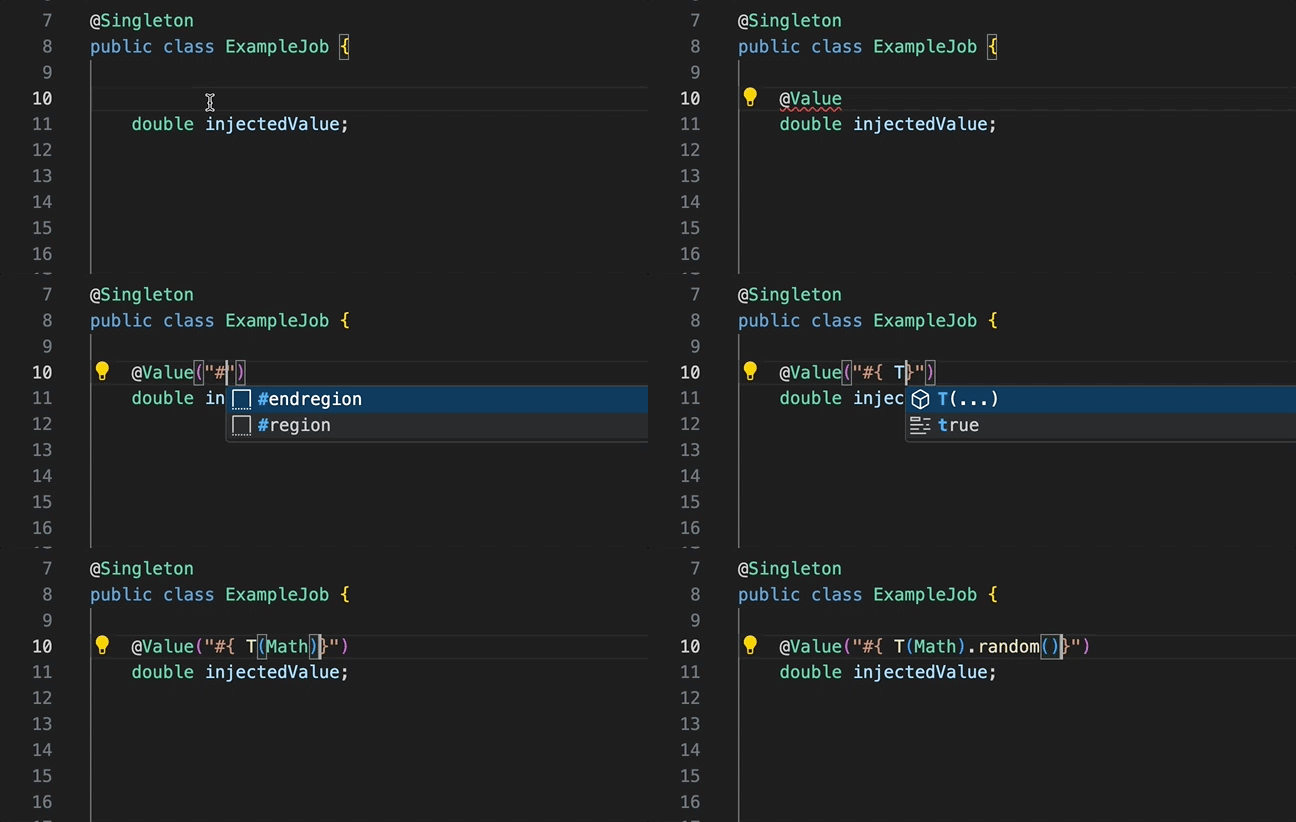
With the addition of the Expression Language in Micronaut Framework 4.0, you can now use embedded evaluated expressions in annotations, using the #{…} syntax. These evaluated expressions enable even more flexibility when configuring your applications.

In the latest release of the Micronaut Tools for VS Code, available when you install the Graal Cloud Native Extension Pack, we have added editor support for the Micronaut Framework expression language. Code completion is now provided while using expressions in your annotations.
Graal Cloud Native Tools Release - 4.2.1

Enhancements for working with Oracle Autonomous Database


Our tools for Micronaut already offer great support for working with Oracle Autonomous Database. With this latest release, you can now create a Micronaut controller class directly from a Micronaut Data repository.

You can also now create data entity classes and data repository interfaces from an existing schema, in an Oracle Autonomous database, and then expose these through an HTTP controller, creating a one-stop REST API from the tables in your database.

Graal Cloud Native Tools Release - 4.2.1

Micronaut Control Panel


The Micronaut Control Panel is a new addition to the Micronaut Framework that provides a web-based UI for viewing and managing the state of your application. We now support adding the required dependencies and configuration to your Micronaut projects from within VS Code to automate the setup of this. You can now launch the Micronaut Control Panel and see its output directly from within VS Code. This feature is experimental and subject to change, but do try it out.

Graal Cloud Native Tools Release - 4.2.1

Support for Kubernetes Config Maps in GCN Apps


This release sees support for the creation of Kubernetes config maps for Graal Cloud Native and Micronaut applications that are deployed to OKE. If the application being deployed makes use of a connection to an Oracle Autonomous Database we now support uploading the database connection details directly into a vault hosted within your OCI tenancy. To find out more about vaults read this. We then create a Kubernetes config map containing the database configuration and, behind the scenes, mount this onto the application containers when they are deployed to OKE. In short, this means you can push your database connection details securely to the cloud and we handle the rest.

There is a blog post describing this functionality coming soon, so keep an eye out for it.

Guides on working with Google Cloud Platform for Graal Cloud Native and VS Code


Last, but by no means least, we are also releasing a guide to walk you through deploying Graal Cloud Native applications to Google Cloud Platform (GCP) Cloud Run, from within VS Code. 

Graal Cloud Native Release 4.2.1


To find out what is being released in the 4.2.1 release of Graal Cloud Native, please check out the Announcing Graal Cloud Native Release 4.2.1 post.

Join us on Slack


We would love to hear any feedback you have on any of the features in this release and we now have a Slack channel in the Oracle Developers Slack workspace. Join the workspace and then join the #graal-cloud-native channel to get in touch.

Source: oracle.com

Friday, May 10, 2024

Unleashing the Power of Graal Cloud Native Tools for Seamless Development

Unleashing the Power of Graal Cloud Native Tools for Seamless Development

In the ever-evolving landscape of software development, staying ahead demands a strategic approach and the adoption of cutting-edge technologies. Enter Graal Cloud Native Tools – a game-changer in the realm of cloud-native development. In this comprehensive guide, we delve deep into the intricacies of Graal Cloud Native Tools, unveiling its unparalleled capabilities and how it revolutionizes the development process.

Understanding Graal Cloud Native Tools


Graal Cloud Native Tools is a suite of tools engineered to facilitate the creation and deployment of cloud-native applications with unmatched efficiency and agility. At its core lies GraalVM, a high-performance runtime that supports multiple programming languages, including Java, JavaScript, Python, and Ruby, among others. This polyglot nature empowers developers to leverage their language of choice without sacrificing performance or interoperability.

The Versatility of GraalVM

GraalVM's versatility extends beyond its support for multiple languages. It boasts ahead-of-time compilation capabilities, enabling faster startup times and reduced memory overhead. Additionally, GraalVM's native image feature allows developers to compile Java applications into standalone executables, eliminating the need for a JVM during deployment. This streamlined approach enhances resource efficiency and simplifies containerization, making it ideal for cloud-native environments.

Key Features and Benefits


Seamless Integration

One of the standout features of Graal Cloud Native Tools is its seamless integration with popular frameworks and platforms. Whether you're building microservices with Spring Boot, developing serverless functions with Micronaut, or deploying applications on Kubernetes, GraalVM provides native support and optimizations tailored to each ecosystem. This ensures compatibility and optimal performance across diverse development stacks, empowering teams to focus on innovation rather than integration hurdles.

Enhanced Performance

Performance is paramount in cloud-native environments where scalability and responsiveness are non-negotiable. GraalVM's advanced optimizations, including Just-In-Time (JIT) compilation and aggressive dead code elimination, deliver significant performance gains compared to traditional runtimes. By harnessing the full potential of modern hardware and optimizing resource utilization, Graal Cloud Native Tools enable applications to scale effortlessly while maintaining low latency and high throughput.

Reduced Footprint

In the era of microservices and serverless architectures, minimizing resource consumption is imperative for cost efficiency and scalability. GraalVM's lightweight footprint and minimal runtime dependencies make it an ideal choice for resource-constrained environments. Whether deployed in a Docker container or serverless environment, Graal Cloud Native Tools ensure minimal overhead, enabling efficient resource utilization and maximizing deployment flexibility.

Real-world Applications


Accelerated Development Lifecycle

The adoption of Graal Cloud Native Tools accelerates the development lifecycle by streamlining build and deployment processes. With faster startup times and reduced memory overhead, developers can iterate rapidly, experiment with new features, and deliver value to end-users at unprecedented speed. This agility not only enhances time-to-market but also fosters a culture of innovation and continuous improvement within development teams.

Improved Scalability and Reliability

Scalability and reliability are cornerstones of cloud-native architectures, and GraalVM excels in both aspects. By optimizing resource utilization and minimizing runtime overhead, Graal Cloud Native Tools enable applications to scale seamlessly in response to fluctuating demand. Additionally, GraalVM's native image feature enhances reliability by reducing the attack surface and eliminating common vulnerabilities associated with traditional runtimes, thereby fortifying the security posture of cloud-native applications.

Conclusion

In conclusion, Graal Cloud Native Tools represent a paradigm shift in cloud-native development, offering unparalleled performance, scalability, and agility. By leveraging GraalVM's polyglot capabilities and advanced optimizations, developers can unlock new possibilities and propel their organizations towards digital transformation. Whether you're building microservices, serverless functions, or containerized applications, Graal Cloud Native Tools empower you to innovate with confidence and embrace the future of cloud-native computing.

Wednesday, May 8, 2024

Announcing Graal Development Kit for Micronaut 4.3.7

Announcing Graal Development Kit for Micronaut 4.3.7

Today, we are announcing Graal Cloud Native is now Graal Development Kit for Micronaut, and the general availability of Graal Development Kit for Micronaut 4.3.7 based on Micronaut framework 4.3.7. Let us look at some of the notable changes in this release.

A New Name


Thanks to feedback from our users, and to better align with the Micronaut framework, we are renaming Graal Cloud Native to Graal Development Kit for Micronaut. We believe the new name clearly articulates the project's vision and purpose. We expect to complete the renaming process soon.

Graal Development Kit for Micronaut (GDK), previously Graal Cloud Native (GCN), is an Oracle build of the open source Micronaut® framework. GDK provides a curated set of Micronaut framework modules that simplify cloud application development, are designed to be compiled ahead-of-time with GraalVM Native Image, and are fully supported by Oracle. GDK modules provide platform-independent APIs and libraries for a set of core public cloud services across Oracle Cloud Infrastructure (OCI), Amazon Web Services (AWS), and Google Cloud Platform (GCP), with Microsoft Azure coming soon.

GDK enables you to easily build portable cloud native Java microservices that start instantly and use fewer resources to reduce compute costs. You can write Java applications once and run them on any supported public cloud—OCI, AWS, and GCP—and avoid cloud vendor lock-in.

Bill of Materials with Micronaut Framework 4.3.7


In this release, we have updated the Micronaut framework version from 4.2.1 to 4.3.7 applying patches to several Micronaut modules. See Micronaut Framework Releases for more information. The GDK 4.3.7 bill of materials contains specific versions of Micronaut framework 4.3.7 modules and their dependencies that are compatible and tested together. This reduces the risk of library incompatibility and version mismatches, and saves you from having to test and figure this out for yourself.

Gradle:

dependencies {
    micronautBoms(platform("cloud.graal.gcn:gcn-bom:4.3.7.2"))
    ...
}

Maven:

<dependency>
  <groupId>cloud.graal.gcn</groupId>
  <artifactId>gcn-bom</artifactId>
  <version>4.3.7.2</version>
  <type>pom</type>
  <scope>import</scope>
</dependency>

GDK 4.3.7 works with both Java 21 and Java 17. GDK modules offer out-of-the-box support for native compilation with Oracle GraalVM for JDK 21 and JDK 17 Native Image. GDK applications compiled ahead-of-time with GraalVM Native Image require far less memory and CPU to run at scale, start up to 100x faster, operate at peak performance immediately, and have a much smaller attack surface compared to their traditional JVM-based counterparts.

Guides for Serverless Functions


This release contains new guides to help you create, deploy and run Serverless Functions on OCI, AWS, and GCP. See guides for more information.

Tools for GDK


The latest release of the tools for GDK brings with it some great updates. Most notably a rename of the extensions that provide support for the Micronaut® framework, the release of the GDK Launcher for IntelliJ Idea, and VisualVM support for VS Code.

Source: oracle.com

Monday, May 6, 2024

Tools for Graal Development Kit for Micronaut 4.3.7

Tools for Graal Development Kit for Micronaut 4.3.7

The latest release of the tools for Graal Development Kit for Micronaut (GDK) brings with it some great updates. Most notably the release of the Graal Cloud Native Launcher for IntelliJ Idea, VisualVM support for VS Code and a rename of the extensions that provide support for the Micronaut® framework.

GDK is the new name for what was previously known as Graal Cloud Native. Our VS Code extensions will undergo a rename in the near future, but for now they still use their old Graal Cloud Native names. Our tools support the latest version of the Micronaut framework, version 4.3.7, in both the GDK launcher and the launcher for Micronaut framework.

Let’s jump in and see the detail of what’s in this release

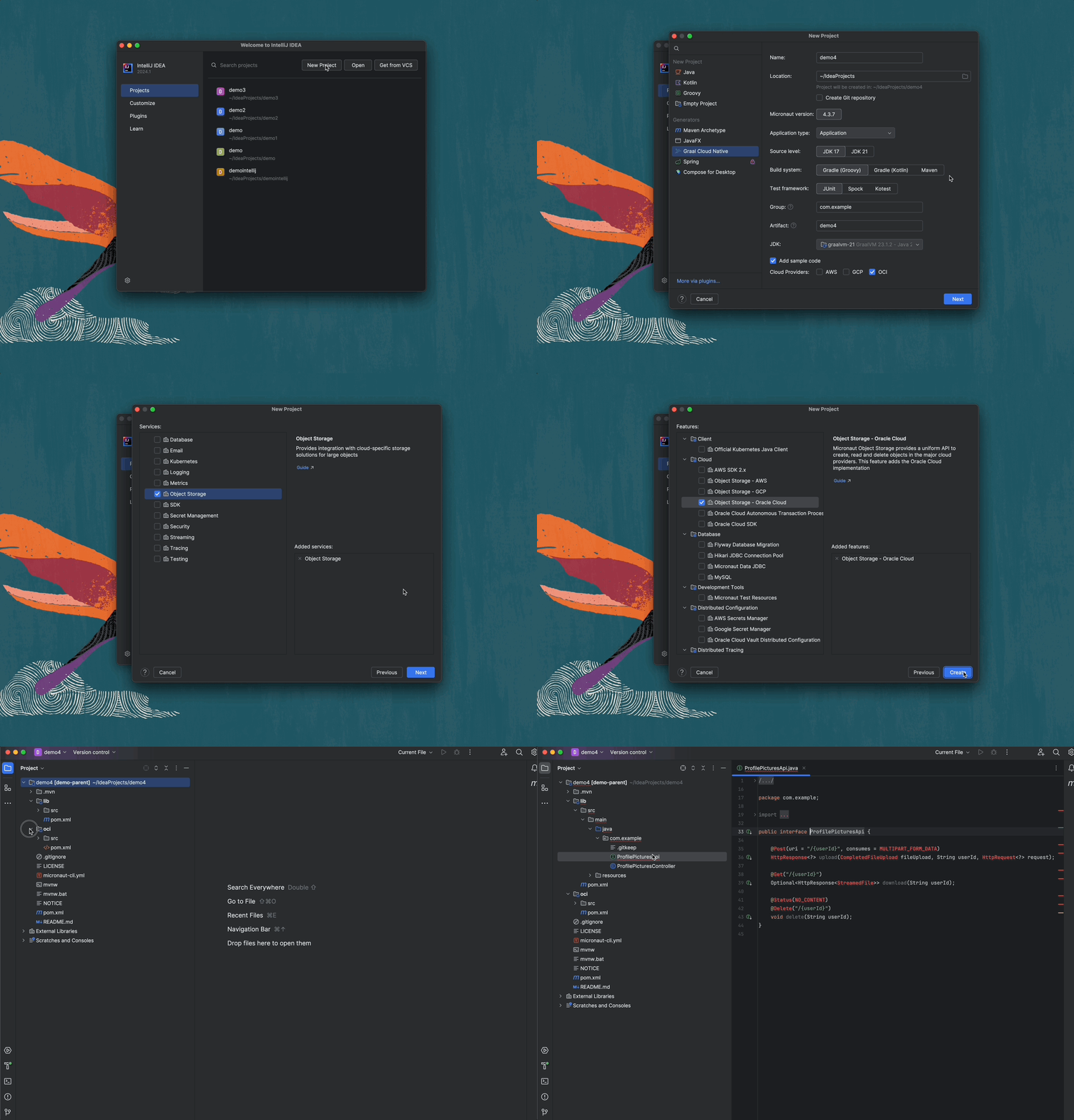
Graal Cloud Native Support for IntelliJ


For some time we’ve had support for creating GDK for Micronaut projects from within VS Code, but with this latest release we are excited to announce that you can now do the same from within IntelliJ Idea!

Tools for Graal Development Kit for Micronaut 4.3.7

The plugin is available within the plugin directory on IntelliJ, just search for, “Graal Cloud Native”. If you are a user of IntelliJ please do give it a try.

VisualVM Integration

Tools for Graal Development Kit for Micronaut 4.3.7

VisualVM is popular visual tool integrating command-line JDK tools and lightweight profiling capabilities. With this latest release we are releasing a new VS Code extension that integrates VisualVM directly into VS Code. This is a stand-alone extension that provides VisualVM support for Micronaut applications. You can now launch VisualVM from within the MIcronaut activity view of your project, making it easy to proflie your application.

Tools for Graal Development Kit for Micronaut 4.3.7

And best of all, from within VisualVM the Go to Source command will navigate back to the open source code within VS Code.

Tools for Graal Development Kit for Micronaut 4.3.7


Rename to Tools For Micronaut framework

Tools for Graal Development Kit for Micronaut 4.3.7

When you install the Graal Cloud Native Extension Pack into VS Code you are installing extensions both for working with the Graal Development Kit for Micronaut and the Micronaut framework itself. With this release we have renamed the Micronaut Tools and Micronaut Launcher extensions to better align with the naming of the Micronaut framework.

The new names for the extension are:


If you have these extensions installed you don’t need to do anything, VS Code will prompt you to upgrade. The extensions are also still accessible under the same page within the VS Code Marketplace.

More Updates to Our Database Support

This release sees the addition of support for the generation of `update` and `get` methods in controllers that provide an API to a Micronaut data repository. You can now auto-generate code to update a domain entity as well as to fetch a specific instance of an entity from the data respoitory. 

Tools for Graal Development Kit for Micronaut 4.3.7

Source: oracle.com

Wednesday, February 7, 2024

Understanding Graal Cloud Native: Unveiling the Dynamics

Understanding Graal Cloud Native: Unveiling the Dynamics

In the realm of cloud computing, Graal Cloud Native stands out as a transformative force, reshaping the landscape of application development and deployment. In this comprehensive guide, we delve deep into the intricacies of Graal Cloud Native, uncovering its mechanisms, benefits, and potential impact on the digital ecosystem.

What is Graal Cloud Native?


Graal Cloud Native represents a paradigm shift in the domain of cloud-native technologies. At its core, it leverages GraalVM, an advanced runtime that provides unparalleled support for multiple programming languages and execution modes. By seamlessly integrating with Docker containers and Kubernetes orchestration, Graal Cloud Native empowers developers to build, deploy, and manage applications with unprecedented efficiency and flexibility.

The Key Features of Graal Cloud Native


Polyglot Capabilities

GraalVM's unique polyglot capabilities enable developers to write applications in Java, JavaScript, Python, Ruby, and other languages, all within a single runtime environment. This versatility not only enhances developer productivity but also facilitates seamless integration with existing codebases and libraries.

Ahead-of-Time Compilation

One of the distinguishing features of Graal Cloud Native is its support for ahead-of-time (AOT) compilation. By compiling code into native machine instructions during the build process, GraalVM eliminates the need for runtime interpretation, resulting in significantly faster startup times and reduced memory overhead.

Microservices Orchestration

Graal Cloud Native seamlessly integrates with Kubernetes, the industry-leading platform for container orchestration. This integration enables developers to deploy microservices-based applications at scale, leveraging Kubernetes' robust scheduling, scaling, and service discovery capabilities.

Enhanced Performance

Thanks to its advanced optimization techniques and efficient runtime, Graal Cloud Native delivers exceptional performance across a wide range of workloads. Whether handling compute-intensive tasks or serving high-throughput web requests, GraalVM's performance optimizations ensure optimal resource utilization and responsiveness.

Cloud-Native Security

Security is a top priority in the cloud-native landscape, and Graal Cloud Native rises to the challenge with built-in security features and best practices. From secure container isolation to encrypted communication channels, GraalVM provides the tools and frameworks necessary to safeguard applications and data in distributed environments.

The Benefits of Adopting Graal Cloud Native


Improved Developer Productivity

By streamlining the development and deployment process, Graal Cloud Native empowers developers to focus on innovation and value creation. With support for multiple programming languages and a unified development environment, teams can collaborate more effectively and deliver high-quality software at a rapid pace.

Enhanced Scalability and Elasticity

The inherent scalability of Kubernetes combined with Graal Cloud Native's lightweight containers enables organizations to scale their applications dynamically in response to changing demand. Whether scaling up to handle peak loads or scaling down to conserve resources, GraalVM's flexible architecture ensures optimal performance and cost efficiency.

Cost Savings

Graal Cloud Native's efficient resource utilization and reduced overhead translate into tangible cost savings for organizations. By optimizing resource usage and minimizing infrastructure requirements, businesses can achieve higher ROI and lower total cost of ownership (TCO) for their cloud-native applications.

Future-Proof Architecture

As technology landscapes evolve and new paradigms emerge, Graal Cloud Native provides a future-proof foundation for innovation and growth. With its modular architecture and support for industry standards, GraalVM enables organizations to adapt to changing requirements and embrace emerging trends with confidence.

Conclusion

In conclusion, Graal Cloud Native represents a quantum leap forward in the realm of cloud-native technologies. With its polyglot capabilities, ahead-of-time compilation, and seamless integration with Kubernetes, GraalVM empowers organizations to build, deploy, and manage applications with unparalleled efficiency and agility. By embracing Graal Cloud Native, businesses can unlock new levels of innovation, scalability, and cost savings in the digital era.